How to Choose Garden Soil That Works in Your Yard
Start with the soil you have. In-ground beds usually need compost or garden soil worked into the native dirt, while raised beds need a dedicated raised-bed blend and containers need potting mix. A soil test should come before lime or fertilizer, especially in Alabama clay, because the right fix depends on what is already in the bed.
Pike Road and Montgomery gardens often start with dense red clay, quick-draining sandy patches, or a mix of both. This guide explains which soil belongs in each planting space, how to read the signs your existing soil needs help, and how to buy the right amount without hauling home bags you will not use.
How to Choose the Right Garden Soil for Your Planting Space
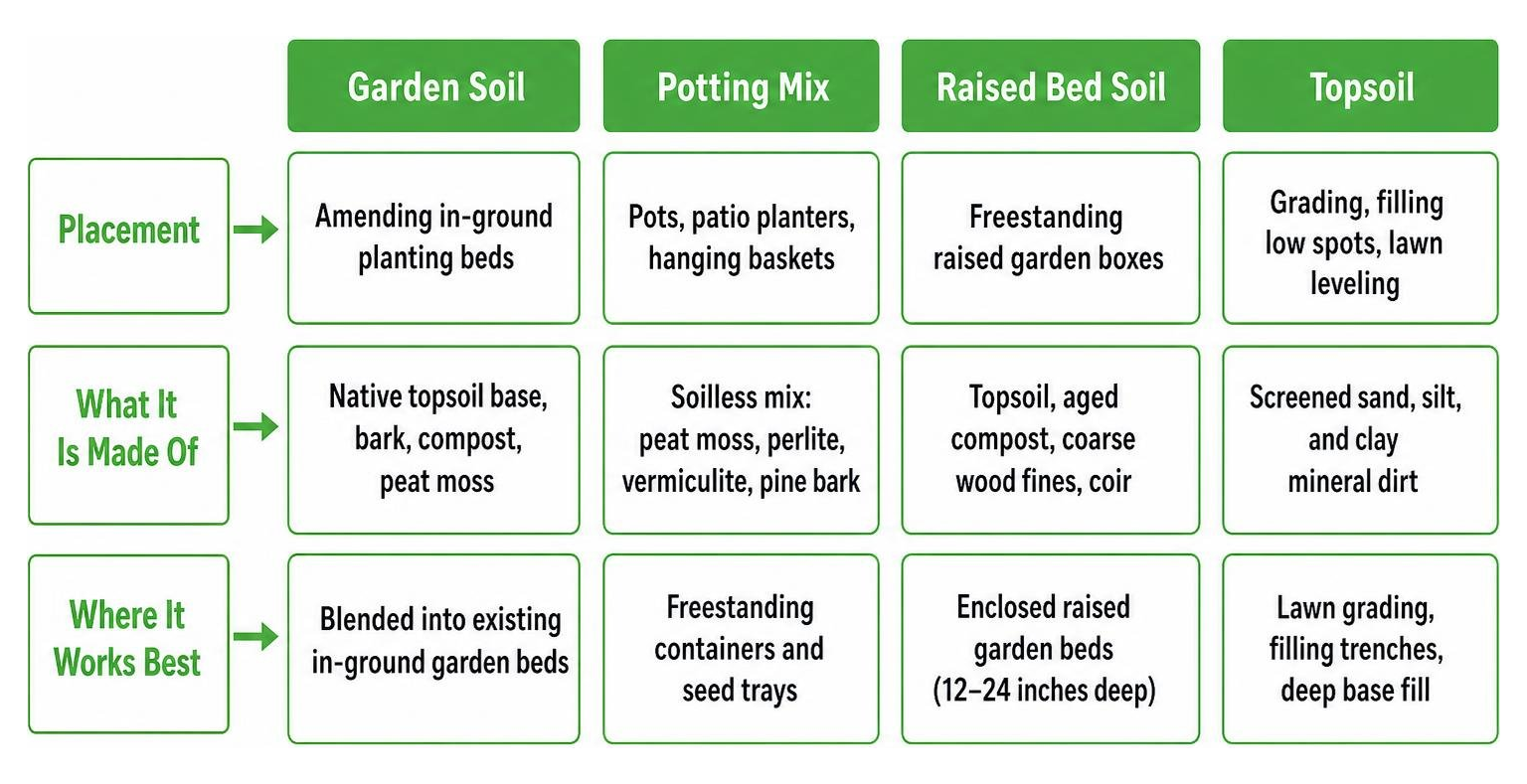
Match the mix to the place it will live: garden soil for in-ground beds, potting mix for containers, and raised-bed soil for framed beds. They are not interchangeable, because each one handles water and air around plant roots differently.
For an in-ground bed, the goal is to improve the soil already there rather than replace it. Containers are different: their closed sides trap moisture, so they need a lighter, soilless mix that drains freely.
| Product Type | Primary Intended Use | Typical Composition | Best Placement |
|---|---|---|---|
| Garden Soil | Amending in-ground planting beds | Native topsoil base, bark, compost, peat moss | Blended into existing in-ground garden beds |
| Potting Mix | Pots, patio planters, hanging baskets | Soilless mix: peat moss, perlite, vermiculite, pine bark | Freestanding containers and seed trays |
| Raised Bed Soil | Freestanding raised garden boxes | Topsoil, aged compost, coarse wood fines, coir | Enclosed raised garden beds (12–24 inches deep) |
| Topsoil | Grading, filling low spots, lawn leveling | Screened sand, silt, and clay mineral dirt | Lawn grading, filling trenches, deep base fill |
If you’re planting a first vegetable bed, our guide to the best plants for beginner gardeners in Alabama can help you choose crops that suit the space you’re preparing. Before you fill pots or a raised bed, this Extension guide to soil, potting soil, and garden mix explains why each one needs a different blend.
What Garden Soil Is Made Of
A useful garden-soil blend feels loose and crumbly, not heavy or slick when damp. Look for ingredients such as compost and aged bark fines, which help clay open up and help sandy ground hold moisture longer.
In the River Region, a good bed should drain after a hard rain but still stay evenly moist during a hot spell. If water sits on top for hours or the bed turns dusty a day after watering, these garden soil basics can help you recognize when the structure needs more organic matter before you add plants.
Garden Soil vs. Potting Mix, Topsoil, and Raised Bed Soil
These products do different jobs:
- Garden soil is made for in-ground beds. It mixes heavy soil minerals with organic material to enrich the ground you already have.
- Potting mix has no actual field soil in it. It’s a sterile, soilless blend of peat moss, pine bark, perlite, and vermiculite that holds moisture without packing down in pots.
- Raised bed soil sits in the middle. It’s lighter than garden soil so it won’t waterlog, but heavier and more moisture-retentive than potting mix.
- Topsoil is straight mineral dirt without added compost. It packs down easily and doesn’t drain well enough for most plantings, so we save it for filling holes or leveling lawns.
Match Soil to Your Plants and Growing Conditions
Central Alabama sits in USDA zone 8b, with humid summers, heavy downpours, and long stretches of heat. That makes drainage and moisture-holding capacity equally important: plants need air around their roots after rain and steady moisture between waterings.
- Vegetables and annual flowers: They want rich, loamy ground that holds moisture but still drains well, so roots aren’t sitting in stagnant water after a heavy downpour.
- Perennials, trees, and shrubs: Loosen the native soil with coarse organic matter so their roots can spread and anchor well. If you’re planting woody ornamentals, our guide to planting trees and shrubs in fall in Alabama walks through the planting approach that works well in the River Region.
- Succulents and Mediterranean herbs: They want gritty, fast-draining mixes with extra coarse sand or perlite, because wet feet can rot them during rainy stretches.
How to Test and Improve Garden Soil in Central Alabama
Before changing your soil, find out what you are working with. A quick texture test shows whether the bed leans sandy, silty, or clay-heavy, while a laboratory soil test shows pH and nutrient levels so you can skip unnecessary fertilizer or lime.

A hand or jar test gives you an initial read on texture, but it cannot replace a lab report. Once you know what you are seeing, managing garden soil can help you connect drainage and structure to the next step, while this guide to evaluating and amending lawn and garden soil walks through how to choose amendments without guessing.
Identify Your Native Soil with a Hand Test or Jar Test
Both tests are easy to do in your backyard with basic supplies:
- The Hand Test: Moisten a handful of topsoil and squeeze it into a ball. If it feels gritty and crumbles right away, you’ve got sandy soil. If it feels smooth and holds together loosely, it’s silty. If it feels sticky and holds its shape, you’ve got heavy clay — welcome to much of Central Alabama.
- The Jar Test: Put soil in a clear quart jar until it’s one-third full, add water until nearly full, shake it hard, and set it down. Let it settle, then take a look at the layers. More gritty sand on the bottom means sandy soil. More fine, sticky material means clay. It’s a quick way to see what you’re working with before you buy anything.
Test pH and Nutrients Before Adding Amendments
Most vegetables and many landscape plants grow well in slightly acidic soil, generally around pH 6.0 to 6.8. A lab test gives you a clear starting point and keeps you from treating a problem the bed does not have.
- Collect samples correctly: Take small core samples from 10 to 15 spots across your bed, digging down 6 to 8 inches. Mix them in a clean plastic bucket and send a pint to your local county extension office.
- Separate different growing zones: Keep lawn, vegetable bed, and perennial border samples in separate bags, because they’ve had different histories.
- Target your fixes: If your report shows acidic soil below 6.0, you may need agricultural limestone. If it’s alkaline (above 7.2), elemental sulfur can help. We always say: don’t guess on lime. Adding it when you don’t need it can cause more problems than it solves.
Improve Clay, Sandy, or Compacted Soil
Do not add builders sand to heavy Alabama clay. Fine sand mixed into sticky clay can create a hard, dense layer that is difficult to correct later.
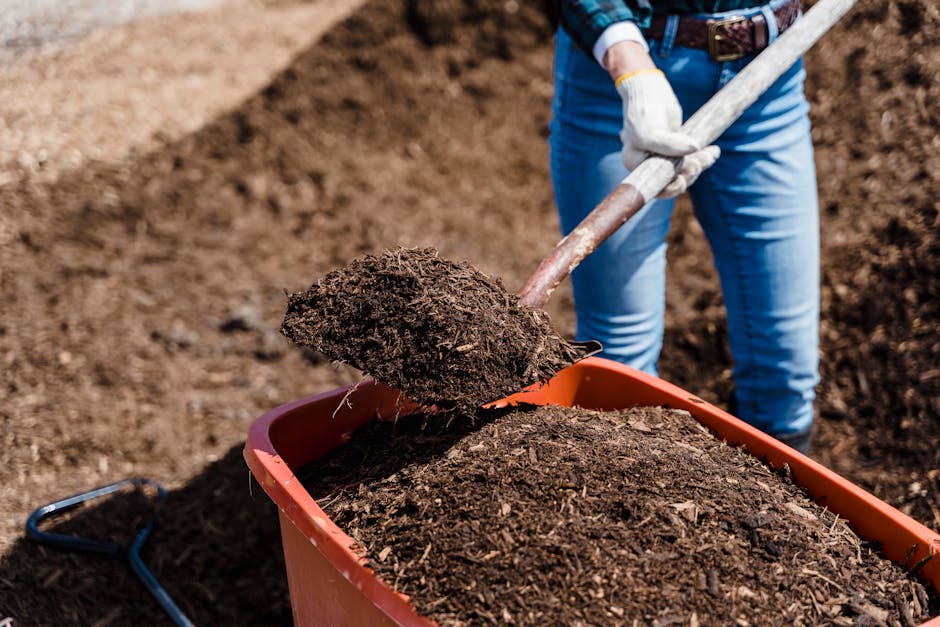
Compost improves both common extremes, but it solves different problems in each one:
- Add aged compost: Spread 2 to 3 inches of compost or aged manure over your beds and work it into the top 6 to 8 inches. It opens up tight clay so air can move through it, and it helps sandy soil hold moisture.
- Plant off-season cover crops: Sow crimson clover, oats, or daikon radishes in late fall. Their roots help loosen compacted ground and add organic matter when you turn the plants in before spring planting.
- Use raised beds where drainage stays poor: If water stands after rain, a bed 12 to 18 inches high gives roots the air they need. That extra depth is especially useful for warm-season vegetables, so you can use our guide to vegetables to plant in June in Alabama once your soil is ready for planting.
Buy, Measure, and Maintain Garden Soil Without Common Mistakes
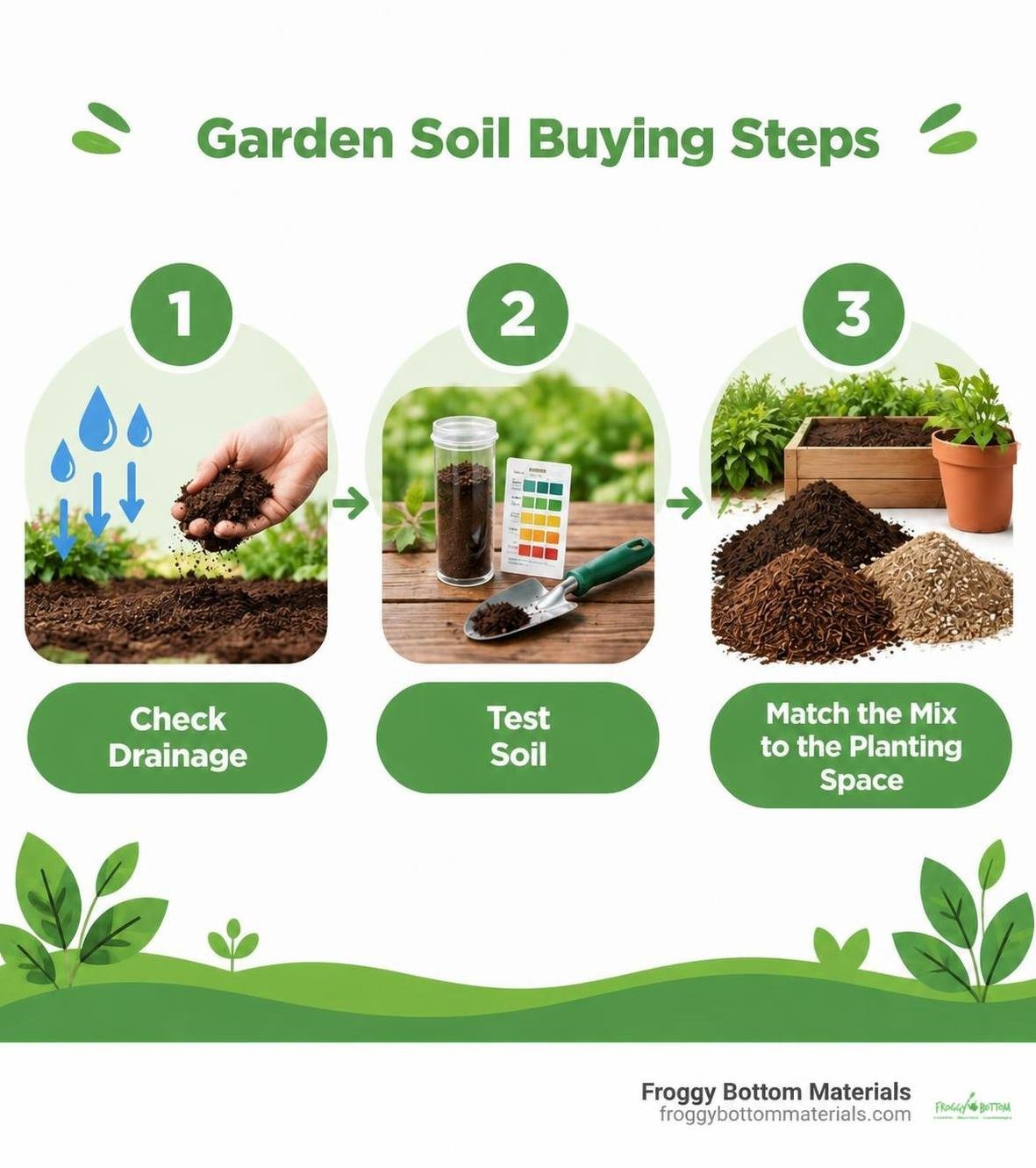
Buy soil after you know the bed’s length, width, and planned depth. Measuring first makes it easier to decide whether bagged material is practical or whether you need a larger amount, and our material calculator can help you estimate it before you browse landscaping products.
When you’re comparing bags at the garden center, read past the big promises and check the ingredient list. The University of California’s guide to bagged garden soils and amendments explains why labels can blur the difference between a planting blend with organic matter and plain topsoil meant mainly for filling or grading.
Calculate How Much Soil You Need
Start by measuring the area you plan to fill and deciding how deep the new soil layer needs to be. Bagged mixes are often labeled by cubic feet, while bulk material is measured in cubic yards; one cubic yard holds 27 cubic feet. Use the steps below to turn those measurements into a practical order.
- Multiply the bed length by the bed width in feet to find your total square footage.
- Determine your amendment depth in feet (for example, 3 inches is 0.25 feet).
- Multiply your square footage by the depth in feet to get total cubic feet.
- Divide the total cubic feet by 2 to find the number of standard bags needed, or divide by 27 to calculate cubic yards.
| Bed Dimensions | Area (Sq. Ft.) | Target Depth | Volume Needed | Standard 2 Cu. Ft. Bags |
|---|---|---|---|---|
| 4 ft × 4 ft | 16 sq. ft. | 3 in. (0.25 ft) | 4 cu. ft. | 2 bags |
| 4 ft × 8 ft | 32 sq. ft. | 6 in. (0.50 ft) | 16 cu. ft. | 8 bags |
| 4 ft × 8 ft (Raised Bed) | 32 sq. ft. | 12 in. (1.0 ft) | 32 cu. ft. | 16 bags (or 1.2 cu. yds) |
| 10 ft × 10 ft | 100 sq. ft. | 3 in. (0.25 ft) | 25 cu. ft. | 13 bags (or 1.0 cu. yd) |
| 10 ft × 20 ft | 200 sq. ft. | 2 in. (0.17 ft) | 34 cu. ft. | 17 bags (or 1.3 cu. yds) |
Buy Quality Soil and Avoid Common Mistakes
When choosing a bagged product, check these details:
- Check the ingredient label: Good garden blends list aged forest products, compost, peat moss, or worm castings. Avoid bags packed with uncomposted wood chips, industrial sawdust, or large bark chunks.
- Inspect bag storage conditions: Avoid bags that have sat in standing water or baked under plastic wrap in direct sunlight for months. That excess heat can kill off beneficial soil microbes.
- Avoid raw animal manure: Always use fully composted manures. Fresh manure burns tender roots and brings weed seeds. For food safety, edible crops should not be harvested within 90 to 120 days of raw manure application (120 days for root crops like carrots and greens like lettuce; 90 days for crops off the ground like peppers and corn).
- Never put garden soil in containers: True garden soil compacts inside pots, turning waterlogged and suffocating roots.
Refresh Soil Instead of Replacing It
Healthy garden soil is built gradually, not replaced every season. Refresh it with compost, mulch, and crop rotation so the structure improves year after year:
- Top-dress annually with compost: Layer 1 to 2 inches of compost over your beds each fall or early spring. Worms and rainfall work it down naturally, so you can skip disruptive tilling.
- Maintain a protective mulch layer: Keep 2 to 3 inches of pine straw or bark mulch over bare ground to hold moisture and keep soil cooler in Alabama’s summer heat. That same mulch routine can make a difference during the dry, hot stretches we cover in our Alabama late-summer flower care guide.
- Rotate plant families: Avoid growing nightshades, such as tomatoes, peppers, and eggplants, or cucurbits, such as squash and cucumbers, in the same spot every year. Rotation helps limit disease buildup and keeps nutrients more balanced.
Frequently Asked Questions About Garden Soil
Can I Use Garden Soil in Pots or Raised Beds?
We don’t recommend pure garden soil in containers or pots. It contains heavy field topsoil, so it compacts tightly inside container walls and blocks drainage. Use a sterile, soilless potting mix for pots, and a specialized raised bed mix for elevated planter boxes instead.
How Do I Know If My Garden Soil Needs an Amendment?
Start by testing your soil texture and sending a sample to your local extension office for nutrient and pH analysis. Standing surface water, stunted growth, pale leaves, or rock-hard crusting are also signs your soil needs organic matter, better aeration, or a pH adjustment.
How Much Garden Soil Do I Need, and How Often Should I Add More?
For in-ground beds, we suggest spreading 2 to 3 inches of quality garden soil or compost and working it into the top 6 inches. You don’t need to replace it each season. Just top-dress with 1 inch of fresh compost once a year to replenish organic matter.
What Is the Ideal pH Level for a Home Vegetable Garden?
Most vegetables and landscape plants grow best in slightly acidic soil with a pH between 6.0 and 6.8. That’s the range we aim for in Central Alabama beds. Test first, then adjust only if your report shows you need to.
What Is the Difference Between Organic and Synthetic Soil Mixes?
Organic mixes get their fertility from natural sources like compost, bone meal, kelp meal, and worm castings, which feed soil microbes and build structure over time. Synthetic mixes use water-soluble chemical fertilizer salts that feed the plant directly, without improving long-term soil biology.
Build Better Garden Beds With the Right Soil
Healthy garden soil is less about finding one magic bag and more about matching the material to the bed, checking what the soil needs, and adding organic matter over time. Those habits make clay easier to work and help plants handle River Region heat and rain.
If you are planning a new bed, refreshing an old one, or figuring out how much material to order, visit the Garden Center on Highway 80 East in Pike Road. We can help you compare bulk materials, garden products, and landscaping services for projects across the River Region. Bring a photo of the spot and your measurements, or call (334) 215-3704 before you come by.